|
Instale el flash plugin
|
|
| |
|
|
Av. de los Patricios: A place of numerous shops and constant activity. Calle Caminito: This pedestrian alley might only be 100 meters long, but it has kilometers of attractions. Its uniqueness is marked out by the typical local houses painted in bright colors, windows filled with flowers, balconies with plants and clothes hanging to dry and murals on its walls, as well as ceramics and every type of ornament. Upon its sidewalks can be seen lively representations of tango, theater (mimes and living statues), plastic art and photography. In its early life it was a branch of the railway, called La Curva, which served as a short-cut – it got its name because it shortened the “camino” – the way. Benito Quinquela Martín, a great personal friend of Juan de Dios Filberto, tango poet and author of the ‘Caminito’ tango, who used to walk down this street every day – suggested the name for the renovated street. Calle Garibaldi: Crossed by the train tracks, reaching the Caminito one block from its origin. A living example of local building style and color. Calle Magallanes: An important pole of attraction for enthusiasts of plastic art and urban landscape. It was mostly on this street that workshops were set up by such artists as Maestri Alfredo Lazzari – teacher of Quinquela Martín and Fortunato Lacámera – and plastic artists Eugenio Daneri, Víctor Cúnsolo, Miguel Diomede, Marcos Tiglio y Miguel Carlos Victorica. the new generations of artists are continuing the tradition. The street begins in Vuelta de Rocha, otherwise known as the Plaza de los Suspiros (Square of Sighs). Calle Necochea: Street where the characteristic ‘cantinas’ proliferate, providing entertainment and gastronomy. Magallanes and Garibaldi: This crossing of cobble stone and grass lining the train tracks was a meeting point for illustrious neighbors such as Filberto, Quinquela, Lacámera and other artists of their status. Vuelta de Rocha: Setting of the armada created by Admiral Guillermo Brown in the Wars of Independence. Considered a Historical Site. Resembles a little estuary in a bend of the Riachuelo. Of note here are a shopping arcade with gifts, crafts and antiques located in the disused steamship Vapor de la Carrera which crossed between Buenos Aires and Montevideo, the Plazoleta de los Suspiros (Square of Sighs) with its mast rescued from some ship lost in time, a walkway with buildings of free architectural style with Italian reminiscences – including the Museum School, the Teatro de la Ribera, the kindergarten and the Insitute of Dentistry – all donated by the artist Quinquela Martín, and the characteristic warehouse of the legendary Mestrina Shipyard. |
|
Share in


 |
|
| |
| See more La Boca | ||
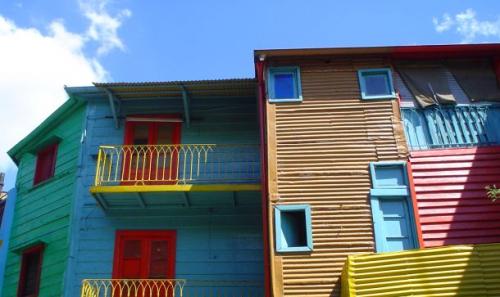 |
Information La Boca is possibly the most splendid barrio of Buenos Aires, filled with color from its humble facades and a permanent activity that possesses the soul of whoever happens to pass through. The barrio was a typical settling place for the working class immigrants of 1860-1930, who were mostly Italian, and specifically Genoan. Owing to its location in the mouth of the po ... ampliar |
|
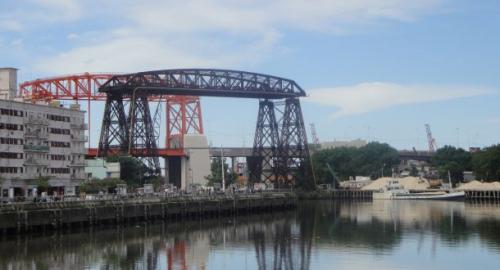 |
History The majority of historical theories on the foundation of Buenos Aires argue that La Boca was the settling place of Pedro de Mendoza in 1536. During the Spanish colonial time, La Boca was a zone of barrack huts where they put up the black slaves. Already at the time of Independence salting houses and tanneries were functioning in the area. Though the mouth of the Riach ... ampliar |
|
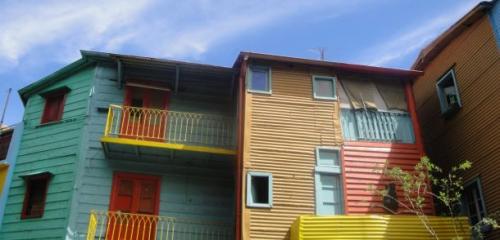 |
Places to visit Calle Museo Caminito: Caminito Street Musuem. Inaugurated in 1859, now the Museo de Arte al Aire Libre (Open-air Art Museum). Feria de la Plaza Vuelta de Rocha: Craft market. Museo de Bellas Artes de La Boca Benito Quinquela Martín: Fine Art Museum. Shows the work of great Argentine painters and sculptors donated by the esteemed master. Includes an exhibition o ... ampliar |
|
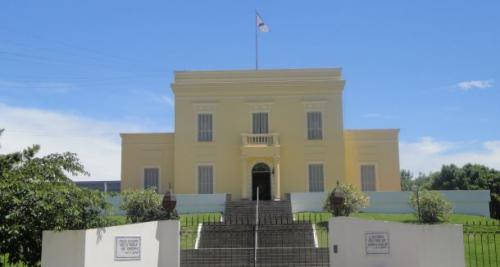 |
Cultural Presence The barrio of La Boca contains a large and diverse cultural life, referred to below. But without doubt the best symbol of what it represents is its original and unequalled. Its houses built out of wood or sheet metal or a combination of the two, iron balconies, corrugated facades, inner walls made out of blocks of wood separating the different rooms as well as decorat ... ampliar |
|
| | ||